“I’ve spent 30 years justifying and trying to explain over and over again what I’m doing with Pacific Couture, right, which is a merging of fashion and art with my own unique aitu afa” – Linda Lepou
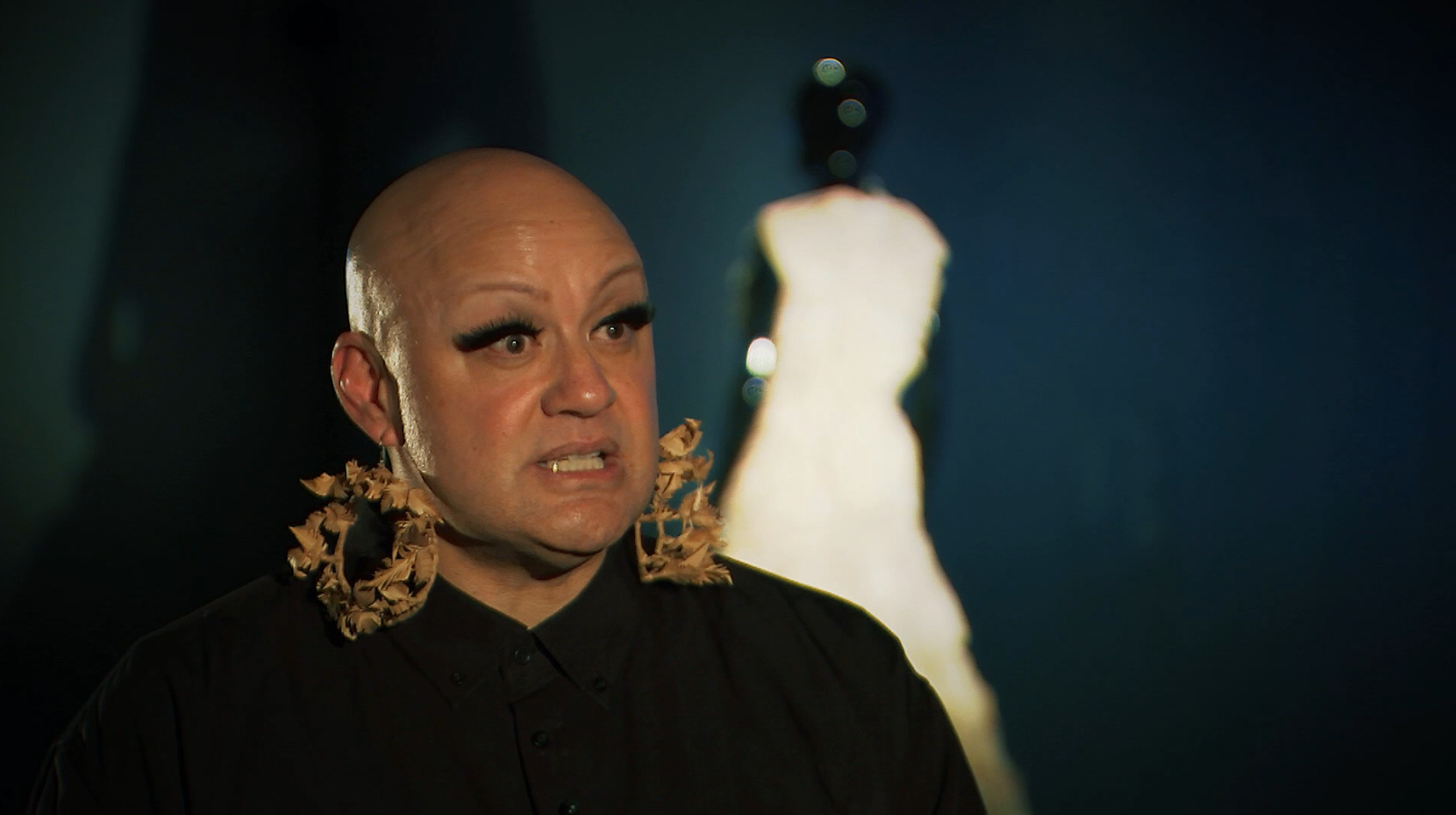
Acclaimed fa’afafine artist Lindah Lepou unveiled her latest work at the Pātaka Art + Museum in Porirua earlier this month.
The multi-disciplinary artist says her latest work Mata‘AITU (voyeur) pays tribute to her past works.
“The inspiration is part of an (AI)TU series that I developed almost two decades ago and this series is a place where I can create with my own Ngafa Aitu,” Lepou says.
“Ngafa, as in whakapapa, and Aitu ancestry spirit threaded through my work because it’s an anchor that allows me to have a more personal approach so this particular work is called Mata’aitu.”
Drawing on her family’s past in stages with two couture dresses on black mannequins and digital AI imagery on display, the exhibition explores issues of colonisation, exploitation and voyeurism.
As part of her research for her latest work Lepou travelled to Germany uncovering a tragic past.
“So, this particular work is looking at a time frame, from 1895 to 2026, there’s three stages to this timeline starting with a young boy that I found in some of my research called Tolio,” Lepou says
“He was a ten-year-old that was taken from Samoa to Germany and put in a zoo on display and he didn’t have his parents.
“So that was mind blowing and he’s a Lepou, so he’s my grandfather’s ancestor.”
Lepou’s research also led her to Robert Flaherty’s 1926 film Moana, which was filmed in Savai‘i, Samoa. She found another family connection; a young 15-year-old woman appearing in the film whom she identifies as her great-grandmother.
“And then we go from the human zoo into new technology of the time. So now we’re looking at cinematic zoos,” she explains.
“And then we come here to this Fa’afafine piece where we are fetishised. But also the irony that we’ve come from this hideous, horrific past, and we’re kind of like setting ourselves up in our own digital zoo.”
Reflecting on a body of work that spans 30 years, Lindah hopes it inspires the next generation.
“I’ve spent 30 years justifying and trying to explain over and over again what I’m doing with Pacific Couture, right, which is a merging of fashion and art with my own unique aitu gafa as an anchor in hopes that it be a possible roadmap for a lot of indigenous artists who are trying to figure out how to communicate or translate their own unique identity, that they may have been oppressed, suppressed and lost even.”
With another milestone in her creative journey behind her Lindah’s looking forward to what comes next
“For a Fa’afafine and with minimal support, forces you to self-fund and, you know, fend for yourself. And, and I think 30 years later, here I am now in the threshold transition period of, what I want to do next.”