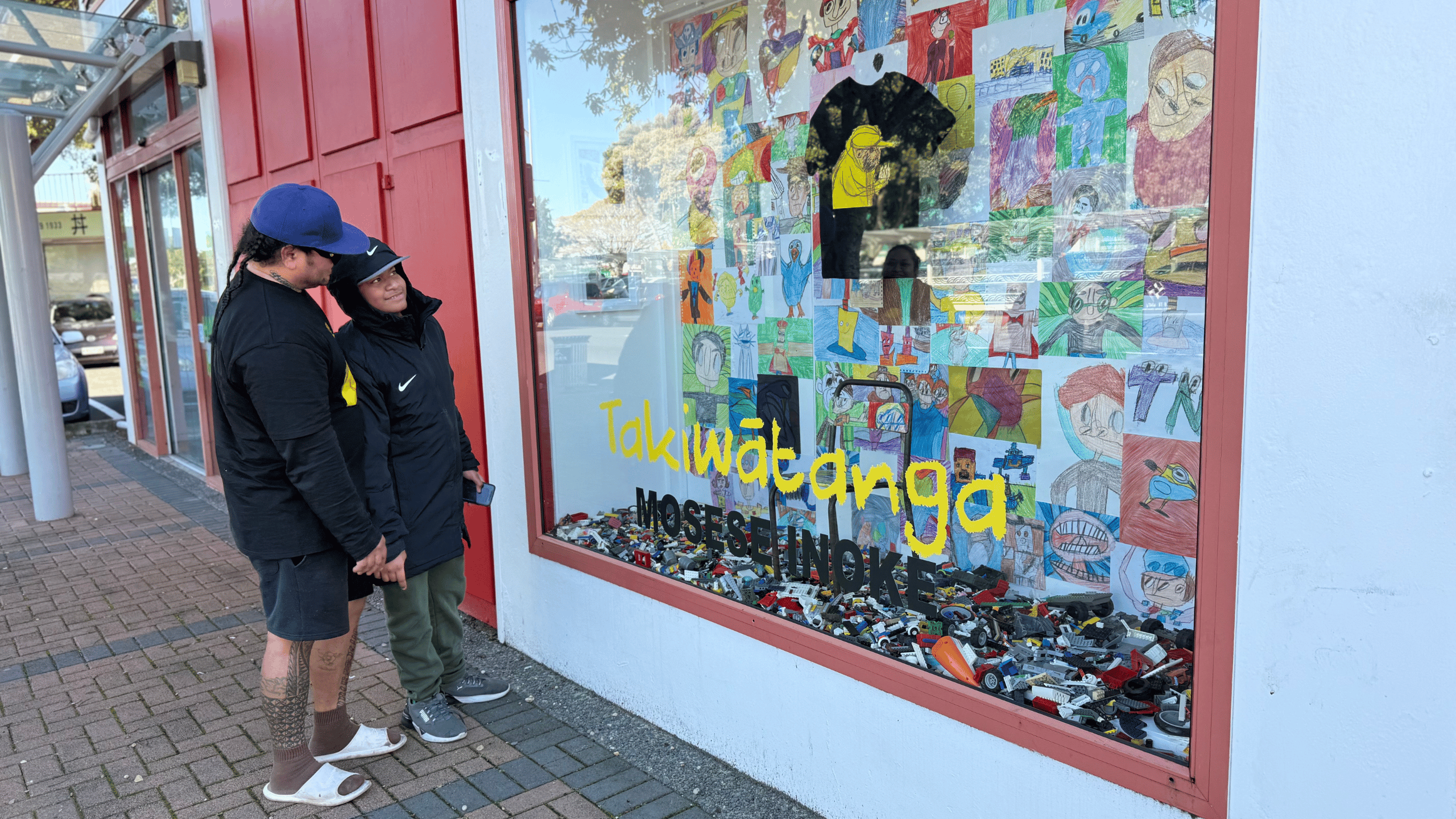
“He’s showing us his world, showing us that things don’t have to be normal in our typical world and that things could be different” – Katie Inoke, Mosese’s mum.
Mosese Inoke has a gift.
The young Tongan artist is autistic and non-verbal, but as his mother Katie Inoke explains, he possesses what some would call a superpower.
“He’s non-verbal and so he speaks through his art, the music, his cartoons that he watches and that’s how we communicate with him,” Katie says.
Their South Auckland home has been transformed into a living gallery, with new works appearing weekly, each serving as a window into his unique point of view.
“He’s showing us his world, showing us that things don’t have to be normal in our typical world and that things could be different, [a] little bit brighter; it doesn’t have to be the normal and it can be wrong, a mixture of things.”
Mosese’s art journey began two years ago when his teacher, Haley Te Rupe (Ngāi Tūhoe, Ngāti Raukawa ki te Tonga, Tūwharetoa), recognised the depth of his talent.
“I noticed a few pieces of art work around the whare and when I finally got into his room and saw the wallpaper of his art it was like, oh my goodness this is amazing,” Te Rupe recalls.
“I came to Kelepi and Katie and I said, ‘your son is an artist,’ and they were like ‘what? He’s an artist,’ and I said, ‘this is our focus.’”
As a mentor and friend, Te Rupe believes Mosese’s creativity offers a lesson for us all.
“His art and what he’s sharing is him leading the way for others, that child-like view of the world and that loving open view of the world,” she says.
“He’s showing us that. It’s almost like he’s telling us that, you know, don’t worry, just don’t worry. Don’t stress, just come along for the ride.”
However, the “ride” is not always easy. Families navigating life with autism often face significant social barriers and a lack of awareness.
Te Rupe is aware that children living with autism are frequently misunderstood and judged by the public.
“Often it is very much misunderstood and whānau are looked down upon, frowned upon, the children are seen as misbehaving, unruly you know it’s misunderstood,” she explains.
“Using this as a vehicle for education in our community is invaluable.”
For Katie, the goal is simple: empathy. “All I hope is for acceptance and understanding for the wider community to understand and to care, just acceptance,” she says.
This mission of acceptance has earned Mosese his very first public exhibition at the Papakura Art Gallery, titled Takiwātanga, by Mosese Inoke.
The milestone marks a turning point not just for Mosese—who now also has his own clothing merchandise—but for the visibility of others’ living with autism to be seen and heard in the arts.
Moses’s story serves as a powerful reminder that communication does not always require a voice. Sometimes, it takes a crayon, a cartoon, and a world of color to truly be heard.