“Culture is our foundation and we want our girls to be able to succeed academically, be excellent, as well as be strong in their cultural identity,” – Principal Bonnie Rae Talamaivao.
Empowering young Pasifika women to be unapologetically brown, beautiful and proud is the driving force behind the newly opened all-girls high school, Sisters United Academy (SUA).
The fees-free high school opened its doors in February this year by welcoming Year 9 and 10 students. The school will expand in a year level annually, with the aim to complete its first cohort by 2029.
Founder and CEO Kendal Collins notes that establishing SUA honours the young girls she saw struggling with their education during her decade-long career as a social worker.
“It started from a small dream of seeing the need of our girls and our system was failing them,” Kendal says.
“Our girls did not fit… do not fit into this system of our schools and so if we could create something magical, if we could create where our girls are celebrated daily, why not take it.”
SUA has only been open for four months and Principal Bonnie Rae Talamaivao says, progress has been ‘rewarding’.
“Seeing the girls love school; seeing the girls love sport, or love science, or love cooking or love animation… it’s the little moments,” she says.
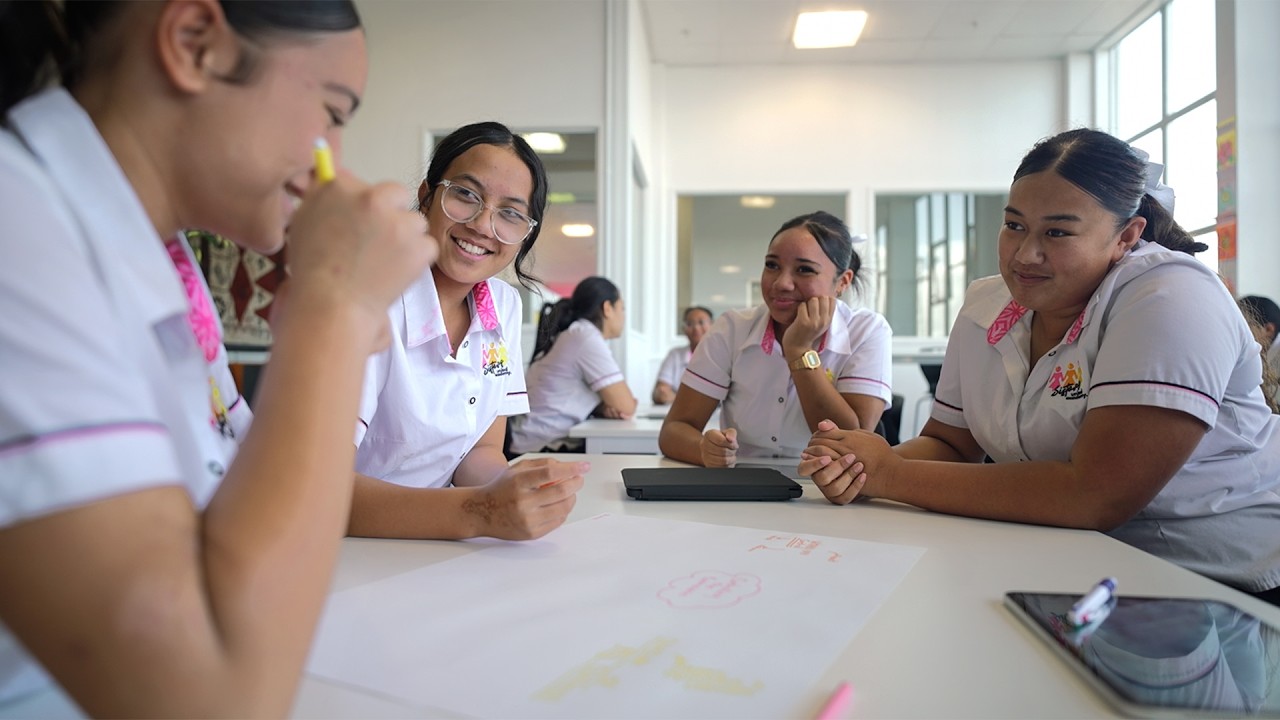
Even in its short span of operation, the school’s success is reflected in the experience of its students. For one of the head girls, Coralmailangi Taukei, choosing to spend her Year 10 years at SUA was based on education support.
“Here at SUA we get more attention, better understanding of maths and there’s no levels,” Coralmailangi says.
“We’re all together in one, if not, we’re all behind. So, nobody is ever left behind in educational classes.”
Seeing the young girls gain confidence and engage more in class reaffirms the vital need for SUA’s education approach.
“They just figured out ‘oh I’m pretty good at this’ and now can give it a go and they have a space now that maybe in traditional schools, some of those opportunities aren’t necessarily seen as for brown girls,” Bonnie says.
“This is a whole school of brown girls which means that every opportunity is for them.”
Sponsored by Sisters United Limited, SUA is one of the new charter schools established under ACT’s charter school policy.
For Bonnie, SUA offers a unique learning environment where culture is celebrated.
“Culture is our foundation and we want our girls to be able to succeed academically, be excellent, as well as be strong in their cultural identity,” she says.
This sense of pride is also embedded in the classrooms.
The morning classes focus on wellbeing or culture and language, while middays are reserved for core subjects such as Maths, English, Science and Social Science. The afternoons are split into academic pathways or passion projects which allows students to gain real life skills from contractors and expert teachers.
“Teachers can come and teach what they teach but if we want our children to be entrepreneurs, you want them to know what the future jobs look like,” Kendal says.
“It’s important for us to connect them to experts in these different industries who are living it in this real world and bringing them and teaching them those skills.”
Although bringing in experts and contractors allows students to connect with real world industries and opportunities, it also raises concerns about teaching standards and learning outcomes.
For charter schools, at least 75 percent of staff need to be qualified. This flexibility – alongside concerns over the privatisation of education and a lack of curriculum requirements – is why The Labour Party wants to disestablish charter schools if they win the election.
According to a Newsroom article, Labour’s education spokesperson, Ginny Andersen says charter schools “can still do all the things they’d like to do, it’s just their teachers need to be registered and they need to be part of the curriculum.”
For Kendal, meeting this standard was a priority.
“All our teachers are qualified and registered which we set from the get-go,” she says.
“On top of that, we do have experts that come in the school which I think is so important… so when our girls leave, they’re not just gonna have ‘yay, I passed NCEA level 3’ and have it on paper.
“[It’ll be] I’ve done that, I’ve done an internship here… They’ve learnt from people from within the community who are doing it actively today.”
With the elections looming and discussions surrounding charter school policies continuing, Kendal’s next focus is less about political outcomes, but more on building long-term connections.
“It’s not about who’s going to be in government at the time, but also about how hard we work to get those outcomes for our young people,” she says.
“I think that SUA will change the way people think education can be for our Pasifika young people. I think this is such a big opportunity that everybody in the education system needs to look at as a positive.
They need to stop connecting it to parties and the people who are supporting it and just see that this is the chance to create whatever you believe will help our young people thrive in an education system.”
One of the approaches SUA aims to enhance student learning for Pasifika girls is embracing AI. Kendal notes that although other schools are ‘steering away from it and seeing it as a negative,’ she sees it as an opportunity to thrive.
“I totally believe that this is something that we’re so far behind in,” Kendal says.
“I’ve heard in so many speeches, ‘we gotta educate, we gotta educate,’ but why not start from our young people?… They are on their phones, they’re using the internet. If we don’t teach them how to use that safely and ethically then we’re not doing our job right.”
She adds, “AI is not taking over their education or telling them how to do it. They’re just showing different ways of how to learn and that’s what’s missing in our public schools.”
But amid all the changes, the pressure and the new ways of learning, it’s the students themselves who redefine what SUA is all about.
For Amanda Lyana Margraff, who is also a head girl, SUA offers a safe space where she can express herself authentically – an environment she felt her previous school didn’t provide.
“Being a big girl at a co-ed school was really hard for me,” Amanda says.
“[At SUA], I feel more comfortable. I feel I can be the person that I am with everything, with fitness, with learning. I feel more confident … and more excited to learn more, more excited to be here at school.”
Ultimately, it’s this supportive environment that encourages students to persevere through setbacks and embrace the future.
“We are gonna fall short sometimes but here at SUA they teach us to pick up after ourselves and keep going and keep striving for the things we want and the goals that we want to achieve,” Amanda says.
“So, nau mai haere mai. Nau mai haere mai, please. You’ll love it here.”
Some quotes have been edited for clarity.